
- How is AI used in transportation and what are its main advantages?
- The brightest examples of AI in transportation
- The technology underneath AI transportation solutions
- Engineering it safely: Why this is harder than the demos suggest
- Where to start: Bringing AI into your transportation system
- The future of AI in transportation
How is AI used in transportation and what are its main advantages?
What is the first thing that comes to mind when you mention AI in transportation? You will probably say autonomous vehicles – and you will be right. Yet, if we are talking about public transport, railways, or commercial fleets, AI is much more likely to predict when a component will fail than to take control of the steering wheel.
Industry-wide adoption of AI is closely linked to the broader transition toward the so-called ACES mobility paradigm (Autonomous, Connected, Electric and Shared mobility – four major trends that are changing modern transportation systems). The table below shows how each of these dimensions contributes to the adoption of AI.
| ACES dimension | System change | How it drives AI adoption |
|---|---|---|
| Autonomous | Real-time sensor-based vehicle control (camera, radar, lidar, GPS) | – Requires continuous interpretation of high-volume sensor data – Depends on real-time decision-making under safety constraints – Shifts driving logic from rule-based systems to learned models |
| Connected | Continuous V2X (vehicle-to-everything) data exchange between vehicles, infrastructure, and cloud platforms | – Creates large-scale, heterogeneous data streams that must be processed in real time – Enables system-wide optimisation instead of isolated vehicle-level decisions – Increases demand for predictive models of traffic and fleet behaviour |
| Electric | Energy-dependent fleet operations with charging infrastructure integration | – Introduces complex optimisation problems for charging and energy usage – Requires prediction of battery behaviour under variable conditions – Links mobility planning with energy system constraints |
| Shared | On-demand mobility and dynamic fleet usage models | – Requires continuous prediction of demand at granular spatial-temporal level – Shifts operations to real-time allocation problems – Increases complexity of pricing and supply-demand balancing |
In all cases, AI reduces the time required to interpret data and take actions based on it.
And the industry appears to agree. In Deloitte’s survey, 99% of transportation executives said they expect AI to transform the sector. The technology is already moving beyond pilot projects: more than half of transportation companies surveyed have active GenAI implementations. In addition, around 80% of organisations that use AI for asset management, route optimisation and warehouse operations report high or very high business value from these initiatives.

Similar trends are noticed in public transportation: 62% of organisations surveyed by UITP (Union Internationale des Transports Publics) are already involved in AI projects, either through pilot programmes or full-scale deployments.
Although AI supports dozens of transport use cases, they most likely fall into one of the three categories below.
On-vehicle AI
If AI has a front row seat anywhere, it is inside the vehicle itself. Modern buses, trains, and commercial vehicles produce plenty of telemetry signals every second. The vehicle stops dozens of times, passengers board and leave, doors open and close, the driver brakes in traffic, accelerates, turns, switches between driving modes, and follows the planned schedule. Throughout this journey, sensors record what is happening inside the vehicle – battery temperature, brake wear, engine performance, and driver behaviour.
If you left the data untouched, it has limited value. But when you combine it with AI, it is a source of operational intelligence that can support engineering decisions every day.
Autonomous driving and ADAS
Fully autonomous public transport is limited to controlled environments such as airport shuttles, campuses, and dedicated transit corridors. For most operators, the immediate business value comes from AI-powered Advanced Driver Assistance Systems (ADAS).
Computer vision models process camera, radar, and LiDAR data in real time to identify collision risks, detect pedestrians, monitor blind spots, and assist with lane positioning. According to NHTSA (National Highway Traffic Safety Administration), close to 94% of all crashes occur in part due to human error. This explains why transport operators view ADAS as a risk-management investment rather than a step toward full autonomy.
Predictive maintenance and vehicle health
Among many AI applications in transportation, predictive maintenance continues to stand out for one simple reason: its business value is unusually easy to measure.
Traditional maintenance assumes that vehicles following the same schedule are subject to approximately the same wear and tear. But two identical buses that operate on different routes may age at completely different rates. AI, by contrast, analyses real operating conditions instead of maintenance calendars.
Machine learning (ML) models evaluate historical maintenance records alongside live telemetry from engines, braking systems, HVAC units, traction equipment, and batteries to identify failure patterns weeks before faults become visible during inspections.
The business impact is already well documented. For railway, for example, McKinsey claims that AI-enabled predictive maintenance can reduce maintenance costs by up to 20% and improve reliability by around 15%.
AI-powered HMI and driver monitoring
Driver monitoring systems use cameras installed inside the vehicle to analyse the driver’s face, head position, and eye movements. AI models can detect signs of fatigue, distraction, frequent yawning, prolonged eye closure, or the driver looking away from the road for too long.
Some systems also combine this information with steering behaviour, braking patterns, and vehicle speed to distinguish between a momentary glance at a mirror and behaviour that indicates an increasing safety risk.
When predefined thresholds are reached, the driver receives an in-cab alert, while the fleet management system can notify dispatchers or record the event for further analysis.
AI also changes the way drivers and maintenance teams interact with the vehicle. Modern buses and trucks can generate hundreds of diagnostic messages during a single shift, but not every alert requires immediate action.
Instead of displaying every fault code separately, AI analyses vehicle telemetry, fault history, and operating conditions to identify the most likely cause of a problem. The system can then prioritise critical warnings, filter out duplicate alerts, and recommend the next action – for example, continue operating until the end of the route, or stop the vehicle immediately if safety could be compromised. This helps drivers focus on the road, and maintenance teams have more context before the vehicle even arrives at the depot.
Network and infrastructure AI
At this level, AI implementation moves from improving a single asset to increasing the performance of the entire system.
Traffic management and adaptive signals
Urban congestion is one of the most expensive challenges for public transport. Delays reduce schedule adherence, increase fuel consumption, and require additional vehicles to maintain service frequency.
AI enables traffic management platforms to anticipate congestion before it develops. Instead of following fixed signal plans, adaptive traffic control continuously adjusts signal timing according to real-time traffic conditions, public transport priority requests, and historical traffic patterns.
Public transit operations
AI models combine passenger counts, ticketing data, weather forecasts, event schedules, and real-time vehicle locations to estimate demand throughout the day. Operators can, therefore, adjust vehicle allocation to avoid overcrowding which affects service quality.
Rail and infrastructure inspection
Rail infrastructure consists of thousands of kilometres of track, signalling equipment, and overhead lines that require continuous inspection.
Thanks to computer vision and AI-powered anomaly detection operators can automate much of this work through cameras mounted on regular service trains, drones, or dedicated inspection vehicles. Engineers receive prioritised alerts ranked by failure probability and operational impact.
Fleet and business-level AI
Running a transport network means making hundreds of operational decisions every day. Which vehicles should go on which routes? When should they return to the depot? How should schedules change if traffic worsens or passenger demand suddenly increases? As AI is capable of processing far more variables than a dispatcher or planner could evaluate manually, it helps answer these questions.
Route optimisation and fleet management
A route that worked well in the morning may become inefficient by the afternoon. Traffic changes, vehicles require maintenance, drivers finish their shifts, and passenger demand moves from one part of the city to another. Instead of adjusting plans manually, operators can rely on AI in transportation management to evaluate these factors continuously and suggest the best course of action. The result is better vehicle utilisation, fewer unnecessary kilometres, and more reliable services.
Shared mobility and demand-based dispatch
Demand-responsive transport depends on one thing: putting the right vehicle in the right place at the right time. That becomes difficult when travel patterns change throughout the day. But AI detects these changes as they happen. Then, it can predict where demand is likely to increase and update dispatch plans accordingly, demonstrating the value of AI in transportation and logistics.
EV-specific AI: battery, charging and range optimisation
Electric fleets require much more than route planning. Operators also need to decide when each vehicle should charge, how to avoid unnecessary battery degradation and which routes match the available range. These decisions depend on battery condition, weather, energy prices, passenger loads and charging capacity. Since AI evaluates these factors together, it can recommend the most efficient charging and deployment strategy for every vehicle.
Not sure where to start with AI?
Our transportation software experts can help you identify the highest-impact opportunities.
The brightest examples of AI in transportation
Predictive maintenance: Siemens Mobility Railigent X
Siemens Mobility replaced fixed maintenance intervals with condition-based maintenance. Instead of servicing trains after a predefined mileage, Railigent X predicts when individual components actually require attention.
Sensor data from the train (like vibration, acceleration, and wheel/bogie condition) is converted into time-series data. Machine learning models then compare this real-time behaviour with a learned ‘normal’ baseline of how a healthy train should perform.
Next, predictive models estimate degradation, such as the Remaining Useful Life of components. In other words, they forecast how long a part can keep operating safely before it needs maintenance.
Finally, optimisation algorithms decide the best maintenance time. This way, both premature repairs and unexpected failures are avoided.
The system can also automatically generate maintenance work orders so that technicians know in advance what needs to be fixed when the train arrives at the depot.
Thus, the AI basically does three things:
- detects anomalies
- predicts wear and remaining life
- optimises maintenance timing.

Siemens reports that the Rhein-Ruhr-Express fleet achieved almost 100% validated availability. Moreover, around 80% of maintenance work orders are generated automatically before engineers approve them.
Track inspection: Google AI for Public Sector + New York MTA
The TrackInspect pilot is a collaboration between the Metropolitan Transportation Authority (MTA), New York City’s public transit agency, and Google Public Sector. It is aimed at using AI to detect railway track defects earlier and improve subway reliability.
The system works by retrofitting subway trains with sensors that capture continuous vibration, sound, and motion data while the train is in service. In the MTA pilot, for example, Google Pixel devices mounted on R46 subway cars collected data from over one million GPS locations, 1,200 hours of audio, and hundreds of millions of sensor readings.
This raw data is streamed in real time to cloud-based machine learning systems that run on Google Cloud, where AI models are trained to distinguish between normal track conditions and early signs of defects. The models combine anomaly detection on vibration patterns with classification of audio ‘signatures’ that indicate issues such as rail irregularities or structural wear.
However, human inspectors remain part of the loop. When the system flags a potential issue, maintenance crews physically verify it on-site. Their feedback is then fed back into the model to continuously improve its accuracy and reduce false positives over time.
Brent Mitchell, Google Public Sector Vice President, claims that the system was able to correctly identify around 92% of defect locations later confirmed by inspectors
“By being able to detect early defects in the rails, it saves not just money but also time – for both crew members and riders,” said New York City Transit President Demetrius Crichlow.
Traffic management: Deutsche Bahn AI transportation dispatch
Deutsche Bahn, Germany’s national railways company, uses AI-based decision-support tools for S-Bahn traffic management. After pilot testing in Stuttgart, the system was deployed in the Rhine-Main and Munich S-Bahn networks. It generates instantaneous recommendations for dispatchers to manage disruptions more proactively and reduce cascading delays. In Stuttgart, the tool enables DB to compensate for delays of up to eight minutes, improving timetable stability and reducing congestion on busy lines.
AI is also used in predictive travel information systems. DB applies machine learning models based on historical and real-time data to improve predictions of arrival and departure times across platforms such as DB Navigator and its website. These systems enhance the accuracy and reliability of passenger information, which is critical for customer satisfaction.
In addition, Deutsche Bahn is also one of many state companies and institutions that uses AI assistants. For example, the voice-based assistant SEMMI provides automated support and improves response times in customer interactions.

Some AI transportation examples from Bamboo Apps
Our team has also delivered successful intelligent transportation solutions.
One example is an AI-powered safety and monitoring system for motorcycle fleets. The solution uses computer vision and sensor data to detect potential hazards in real time and warn riders about collisions, blind spots, unsafe overtaking, and following distance while providing fleet operators with live analytics, telematics, and predictive safety insights.

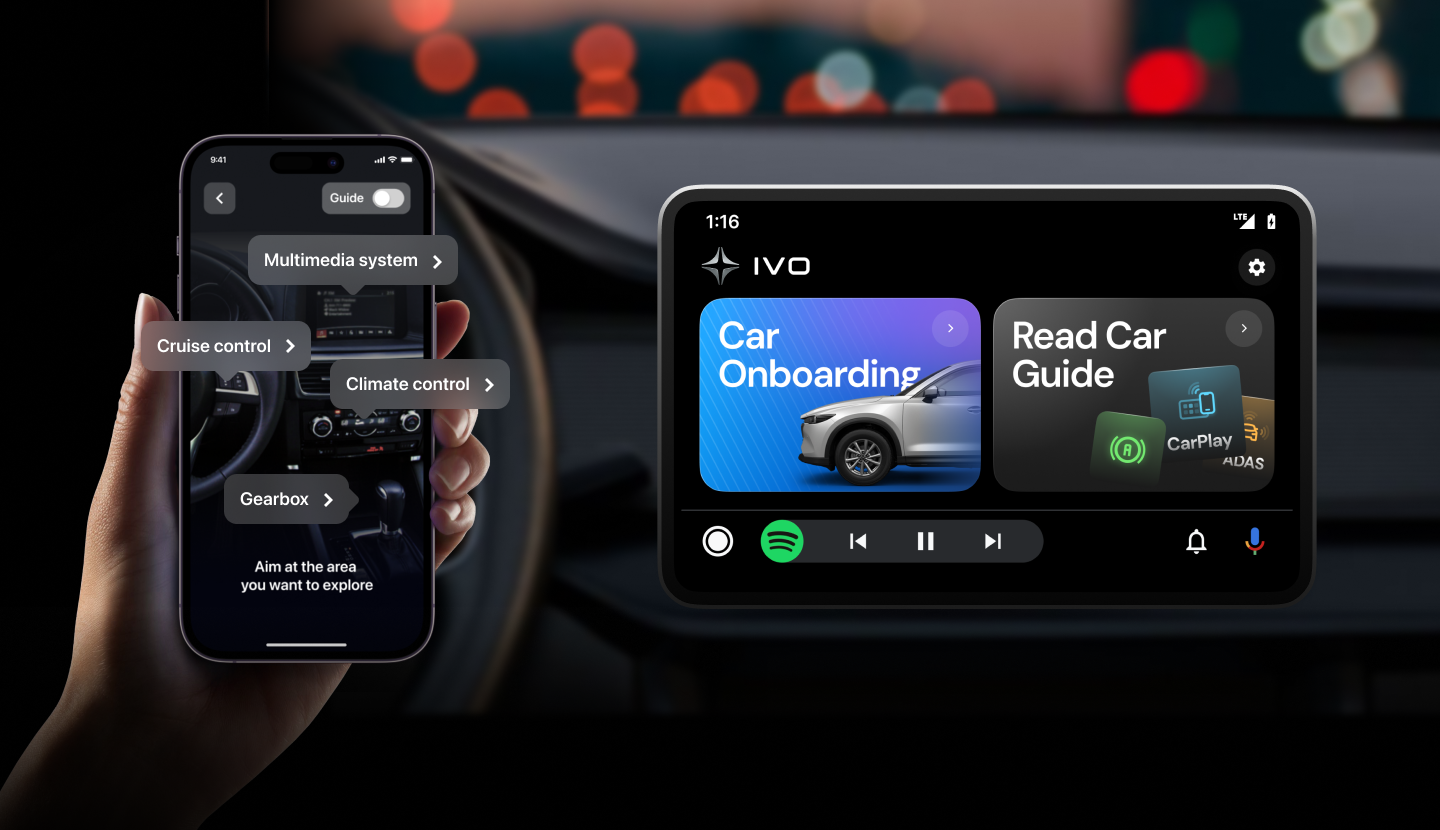
Another example is an ML- and AR-powered in-vehicle onboarding system (IVO) that helps drivers quickly learn how to use modern vehicle features. It combines augmented reality, computer vision, and a contextual voice assistant to explain vehicle functions, provide situational guidance during trips, and deliver proactive safety recommendations. IVO makes advanced vehicle technologies more accessible and safer to use.
The technology underneath AI transportation solutions
Machine learning
Machine learning is at the heart of most AI-driven transportation systems. It allows algorithms to learn from data such as traffic flow, vehicle sensor readings, or driver behaviour and make predictions or decisions based on that data without explicit programming.
| Input data | What ML does | Output in transport systems |
|---|---|---|
| Vehicle telemetry (speed, braking patterns, fuel/energy use, engine diagnostics) | Learns normal vs abnormal performance patterns, detects gradual degradation and anomalies over time. | Predicts component wear (brakes, engine, battery), generates maintenance alerts, and estimates failure probability and remaining useful life (RUL). |
| Historical trip data, passenger counts, logistics demand history | Learns normal vs abnormal performance patterns, detects gradual degradation and anomalies over time. | Forecasts passenger demand per route/time, optimises fleet scheduling, and improves dispatching and capacity planning. |
| Driver behaviour data (acceleration, harsh braking, cornering, adherence to speed limits) | Classifies driving styles, risk profiles, and unsafe behaviour patterns using supervised and unsupervised learning. | Produces driver risk scores, triggers real-time safety alerts, and supports insurance pricing and coaching systems. |
| Traffic flow data (GPS traces, road sensors, congestion patterns) | Learns dynamic traffic evolution and correlations between time, location, and congestion levels. | Predicts congestion hotspots, optimises routing in real time, and improves ETA accuracy. |
Computer vision
Computer vision lets AI systems interpret visual data from cameras and sensors. It converts images and video streams into structured information for real-time decision-making.
| Input data | What CV does | Output in transport systems |
|---|---|---|
| Roadside and in-vehicle camera feeds | Detects and tracks objects (vehicles, pedestrians, cyclists), recognises lane markings, traffic lights, and signs in real time. | Enables ADAS/autonomous perception stack – object detection, lane keeping support, collision risk estimation, and traffic rule recognition. |
| Infrastructure imagery (roads, rail tracks, bridges, tunnels) | Detects surface defects, structural anomalies, and visual degradation using segmentation and classification models. | Generates maintenance prioritisation maps, defect localisation reports, and automated inspection results for civil infrastructure. |
| Multi-sensor input (camera + radar + LiDAR) | Uses sensor fusion to combine spatial and visual signals into a unified 3D environment representation. | Builds real-time 3D scene understanding for autonomous driving – distance estimation, trajectory prediction, and obstacle tracking. |
| Traffic surveillance video streams | Continuously analyzes movement patterns, counts objects, and detects incidents (stopped vehicles, collisions, congestion buildup). | Produces real-time traffic state models, incident detection alerts, and adaptive signal control inputs. |
NLP, Generative AI and In-Vehicle Assistants
Natural Language Processing (NLP) and generative AI in transportation and logistics systems are responsible for understanding, structuring, and generating human language across operational and user-facing applications.
| Input data | What NLP / GenAI does | Output in transport systems |
|---|---|---|
| Maintenance reports, incident logs, technician notes | Extracts structured entities (fault types, components, severity), clusters similar incidents, detects recurring failure patterns across fleets. | Generates structured fault databases, highlights systemic issues across vehicle models, and supports predictive maintenance knowledge bases. |
| Operational alerts, telemetry summaries, system logs | Compresses large volumes of technical data into human-readable explanations and prioritises critical events. | Produces automated fleet health reports, executive dashboards, and real-time operational summaries for dispatch teams. |
| Customer service queries and passenger messages | Performs speech-to-text, intent recognition, as well as context-aware dialogue management. | Enables in-vehicle assistants for navigation control, vehicle settings, route changes, and hands-free system interaction. |
| Traffic surveillance video streams | Interprets intent and generates responses or actions across transport systems. | Powers chat-based journey planning, disruption notifications, and automated passenger support systems. |
Engineering it safely: Why this is harder than the demos suggest
AI deployment in transportation is constrained by a multi-layered framework of regulation, safety certification and cybersecurity standards. Different from demos or pilot projects, production systems must comply with all layers simultaneously before they can be used in real vehicles or infrastructure.
Regulatory framework
AI systems are governed by a growing set of global regulations focused on safety, transparency, and data protection.
The EU AI Act introduces a risk-based framework for high-impact AI systems, including mobility and autonomous driving applications.

The GDPR regulates the collection and processing of personal and location data generated by connected vehicles and mobility platforms.
In the United States, the Blueprint for an AI Bill of Rights (2022) defines principles for safe and transparent AI use, including data privacy, algorithmic accountability, and protection from unsafe system behaviour.

At the global level, ISO/IEC 42001 sets requirements for AI management systems, covering governance, risk management, and lifecycle controls for AI deployment.
Functional safety and automotive certification
Beyond general regulation, AI transportation solutions must comply with strict functional safety and software engineering standards.
ISO 26262 (functional safety) defines safety requirements for road vehicle systems, including ASIL risk classification, hazard analysis, and verification procedures for safety-critical functions such as braking, steering, and perception.
SOTIF or Safety Of The Intended Functionality (ISO 21448) addresses risks that arise not from system failure but from limitations in intended functionality. In AI systems, this includes perception errors in edge cases such as unusual weather, lighting conditions, or rare road scenarios.
ASPICE (Automotive Software Process Improvement and Capability Determination) enforces process maturity, traceability, and quality management across the software development lifecycle. For AI systems, this requires full traceability from data and model training to system-level validation.
In short, these standards ensure that AI components are fully tested, documented, and validated before deployment in safety-critical environments.
Cybersecurity for connected vehicles
Connected and software-defined vehicles expand the attack surface of transportation systems. Therefore, cybersecurity is a core requirement for AI deployment.
ISO/SAE 21434 defines cybersecurity engineering requirements for automotive systems across the vehicle lifecycle, including threat analysis, risk assessment, and mitigation strategies.
AI systems introduce additional risks such as:
- adversarial attacks on perception models
- data poisoning during model training
- manipulation of sensor inputs in connected environments
- model extraction or reverse engineering.
To mitigate these risks, production systems implement:
- encrypted and authenticated communication between vehicle, cloud, and infrastructure
- cryptographic validation of software and AI model updates
- runtime monitoring for abnormal model behaviour
- strict separation between safety-critical and non-critical AI functions.
Where to start: Bringing AI into your transportation system
Phase 1. Readiness assessment
The first phase would usually be focused on understanding whether the operational environment is even suitable for AI and what level of data and system visibility exists. So, at the very beginning, you should conduct the following research.
- Map out how decisions are currently made across the system. You need to identify where planning, dispatching, maintenance, and routing decisions happen, what data they rely on, and which parts of the process are manual, rule-based, or already automated.
- Determining what the system can actually ‘see’. In many cases, data exists but is not accessible in a usable form or is split across multiple disconnected systems. So, define whether AI is immediately feasible or the system first requires instrumentation and integration work.
- Evaluate data quality and structure. Even when data exists, its usability for AI is not guaranteed. Typical issues include missing timestamps, inconsistent identifiers across systems, gaps in sensor coverage, and different levels of granularity between sources. Historical data may also reflect operational changes over time, making it difficult to use directly for training models.
- Identify feasible AI problem framing. Instead of starting with predefined solutions, teams typically work backwards from available signals to determine what types of predictions or optimisations are realistic. In many cases, initial ideas are simplified or re-scoped based on data limitations. Here, predictive maintenance, demand forecasting, or routing optimisation are often validated or rejected as viable starting points.
- Check whether AI outputs can actually influence operations. This means assessing whether systems such as fleet management platforms, dispatch tools, or maintenance workflows can consume model outputs in real time or near real time.
Talk to our team about the right AI strategy for your transportation product.
Phase 2. Execution
So, the operational environment has been assessed, and the data landscape is understood. At this point, you should think of how to turn prepared data and defined use cases into a functioning AI transportation system.
- Move from problem definition to model design. This includes defining inputs, outputs, and success metrics in operational terms rather than abstract accuracy measures.
- Build and test an initial model. An initial model is developed using historical and available operational data. This stage is iterative, with repeated testing under different conditions to understand how the model behaves across variability in data quality, geography, or operating environments.
- Connect outputs to a controlled environment. Before full deployment, model outputs are introduced into a controlled operational setting. This may involve shadow mode testing, where predictions are generated but not used for decision-making, or limited rollout within a specific fleet segment or geographic region.
- Integrate into live workflows. Once validated, AI outputs are gradually connected to fleet management platforms, maintenance planning tools, or dispatch systems.
- Scale and stabilise. After initial deployment, the system is expanded across additional use cases, fleets, or operational regions.
As this process shows, successful AI implementation requires careful preparation, multiple validation stages, and a solid understanding of transportation operations, software architecture, and data ecosystems. Overlooking any of these steps can delay the project or limit its impact.
If you need support, Bamboo Apps can help at any stage. We have more than 20 years of automotive software development experience.
Our team works with OEMs, Tier-1 suppliers, fleet operators, insurers, and mobility providers. Companies such as Jaguar Land Rover, Škoda, Mitsubishi Electric, Zurich Insurance, and Gentherm have trusted us with their software development projects.
We also strictly follow industry standards, including ASPICE, ISO 26262, and ISO 27001.
If you are still evaluating AI or planning your first use case, we are happy to start with a conversation and help you define the right next steps.
The future of AI in transportation
The future of this field is expected to be driven by rapid scaling of operational AI systems across logistics, fleet management, and mobility infrastructure. The Business Research Company indicates that the global AI in transportation market is expected to grow to $11.17 billion in 2030 at a compound annual growth rate (CAGR) of 20.5%.

Long-term modelling of logistics systems suggests continued efficiency gains from AI-enabled planning and routing, with potential cost and fuel reductions in the 10-15% range at scale, depending on fleet structure and network complexity. These improvements are expected to compound as AI systems become more tightly integrated with real-time data from vehicles, infrastructure, and supply chain platforms.
A key structural shift in the coming years will be the move toward fully integrated mobility intelligence systems, where AI continuously optimises transport flows across fleets, depots, and infrastructure networks. This will shift the industry from isolated optimisation tools toward system-wide coordination of movement, capacity, and energy use.
We asked Maxim Leykin, CTO at Bamboo Apps, to share his view on challenges in automotive IoT. Here is what he has to say.

In my opinion, the most significant impact will be seen in logistics and fleet management, where AI will optimise routes in real time by considering traffic conditions, weather, vehicle status, and customer demand.
This will help reduce operating costs, shorten delivery times, and lower carbon emissions.Another major area of development will be predictive maintenance. Instead of relying on fixed maintenance schedules, companies will use AI to analyse telemetry and sensor data to detect potential failures before
they occur, reducing unplanned downtime and improving fleet reliability.Adoption of autonomous vehicles will increase, although still remain slow due to safety, regulatory, and legal considerations. In the near term, autonomous solutions will be adopted primarily in controlled environments
such as logistics hubs, ports, warehouses, and highway freight operations.The combination of AI with IoT, intelligent transportation systems, digital twins, and V2X communication will create a safer, more efficient, and highly connected digital infrastructure within the transportation ecosystem. As a result, AI will become not just an automation tool but a core decision-making technology across the entire transportation industry.
Maxim Leykin, Chief Technology Officer at Bamboo Apps
Taken together, these trends suggest that AI is moving from a supporting role to becoming central to how transportation decisions are made. If you’re exploring how this applies to your fleet, logistics, or transportation systems, our team is happy to talk it through.